Oleksandr Yukhno · e-CV
CV Story
EN UA

Operational transformation · PMO and change management · AI in processes

I turn technology into business processes that work. Now with AI.

I started in electronics, wrote software, managed projects, served as a CTO, and then ran the project office at Silpo, one of Ukraine’s largest retail chains. I see a company as a system where processes, technology and finance, together with employees and customers, have to work as one, and that is how I build change. For me, AI is a tool: an exoskeleton within this system.

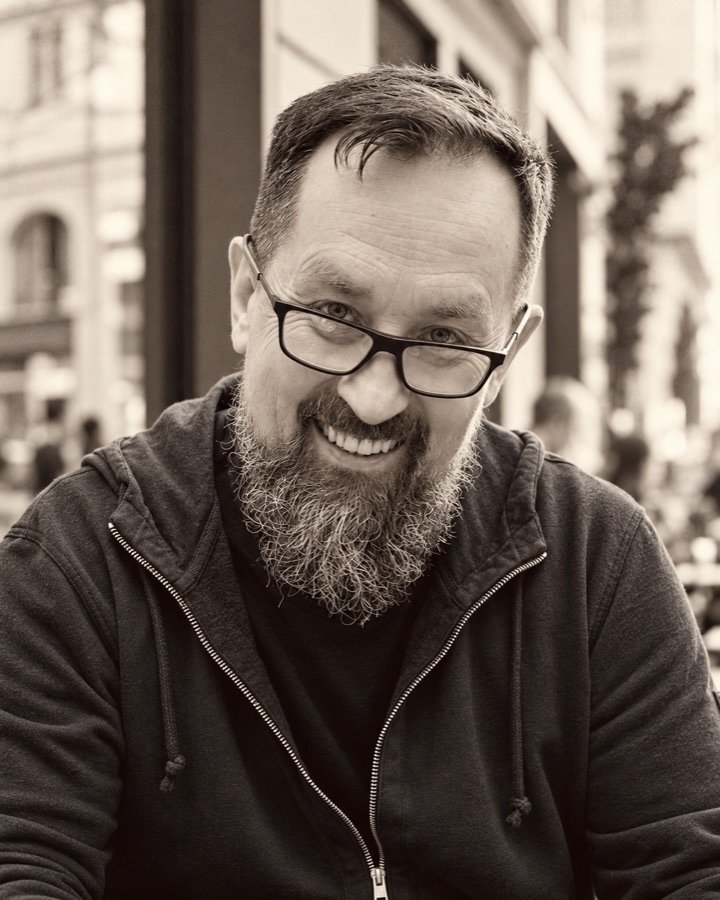
Oleksandr Yukhno, smiling, at an outdoor café
Currently in Poland
from Ukraine
Remote, hybrid, travel · open to relocation within Europe · professional working English Message me on LinkedIn Download CV (PDF)
Career30+ yearsin technology, projects and operations
Ciklum · CTO50 → 250people while I was there; several times larger today
Silpo · IT and PMO Director120 → 300stores during my tenure, about 40,000 people
My AI tuning method5 awardsin 2026 car-audio championships

I can help companies that are changing and rebuilding their operations. I am looking for projects and roles in operational and AI transformation, where the PMO becomes the centre of change management and I am responsible for results.

01 · How I can help

What business needs now

I can connect strategy, operations, technology and the real work of people. Four current top-level challenges from my experience, and a fifth, new one: AI that really improves efficiency.

  1. Bringing operations and the commercial side together in tools that drive financial results

    Give operational teams the tools they need in their daily work to see their contribution and manage results. At Silpo, store managers received their store’s P&L, and the commercial division saw the profitability of every product category in every store after all costs.

    The store P&L was available by the 5th of the following month and showed only the costs a manager can influence. For categories, we took into account shelf space, the area of production zones, equipment energy use, driver-based cost allocation, and price promotions and other promotional activities, to see real profitability. Production areas turned out to be especially sensitive, for example: they have higher utility costs and more expensive skilled staff.

  2. A balanced scorecard (BSC) that worked in practice

    At Silpo, I introduced management by objectives to balance the metrics of different functions against each other: goals cascaded from the C-level down to every store, with plan vs. actual in operational dashboards. Every week and month, each store received an overall score: customers, staff, processes, finance, productivity.

    Data was rolled up by store group, region and the whole chain, with trends by month, quarter and year. Metrics had different weights, and finance was only part of the score. Over-achievement on many metrics was capped, so as not to reward what the team does not control: for example, higher revenue because a carnival that nobody had planned for passed nearby.

  3. Managing workforce productivity: from the annual budget to yesterday’s plan vs. actual

    At Silpo, I ran a project to set labour standards for store processes based on revenue. On that basis, I built the annual budget planning system and introduced operational tools to control shift planning and target achievement by day and week. This made it possible to adjust the workload in time to meet monthly payroll targets. The result: a controlled impact on EBITDA.

    Staffing needs (FTE) were calculated from planned revenue, processes and the target service level. Then came monthly plans, HR hiring plans that allowed for seasonality and staff turnover, and weekly shift schedules. Actuals were checked against receipts, sales and staff clock-in and clock-out records.

  4. Extensive experience of systemic change: acquisitions, restructurings and building a PMO

    At Silpo, I built and led the project management office (PMO). I know how to set up a PMO as the centre of change management in a company. Management can then see what works, what blocks results and where a decision is needed. Every change is locked into processes and into control and monitoring systems, and cascaded through metrics and goals.

    While I worked at Silpo, the chain grew from about 120 to 300 stores. I ran large acquisition and restructuring projects, merged more than 20 legal entities into one and designed an organisational structure for managing change in the stores. I delivered a systemic change across the whole chain: new processes and risk-based cycle counting (calculating what to count and when in partial counts during the year) led to an annual full stocktake instead of a monthly one, and automation on a mobile platform helped lock in the changes and repeat this and dozens of other processes over time.

  5. The new challenge: systematic use of AI that genuinely improves efficiency, with a controlled payback

    Everything is changing very fast now, and there is no time to wait until the old processes are put in order. I propose not just adding AI to existing processes, even ones revised “for AI”, but rebuilding how the company works together with people who already know how to work with AI and use that knowledge to shape requirements and the vision. It is important to build “Digital Management”: a single, transparent system for running the company and making decisions. Research by leading analysts supports this: the gains appear when work is rebuilt with AI from the start.

    1. Engage and train people: give them a personal AI assistant so they take the first steps themselves, create their own solutions and feel the power of the exoskeleton.
    2. Let the people who run the processes redesign them, with outside consultants where needed.
    3. Build a company-wide system for knowledge, risk assessment and company management. I see three ways to use AI: faster IT development, broader analytics, and AI in products and processes that takes over routine work while decisions stay with people.
02 · First steps

How I see the first 100 days

AI can bring quick results, but how far they go depends on which data the company’s security rules allow AI to work with. So I start by assessing these constraints. Using AI effectively under strict security requirements is often a task of its own.

  1. Goals and directionUnderstand where the company is going: its goals, priorities and the direction of change.
  2. Pain points and quick winsFind the most pressing problems and the areas that can deliver quick, tangible results, so the start pays for itself right away.
  3. Team, plan, deliveryForm the team, set goals, draw up plans, then coordinate and implement. With AI, each step goes much faster than usual.
  4. Scaling AIHow AI is scaled depends on the company’s goals and the role it gives to AI. It can mean building new solutions, helping each employee in their daily work, or a company-wide system that connects people’s knowledge and work.
03 · Experience

From circuits to a retail chain, and on to AI

Over the years my view changed: from “how do we build it and what does it cost” to “how do we organise it and when does it pay back”, and then to “who do we do it with and how cost-effective is it”.

1987–1996

Electronics and programming

Kharkiv Technical School of Radio Electronics, with a focus on CNC machine tools: circuits, sensors and machines that do exactly what the program tells them. Then Kharkiv Polytechnic Institute, computer science and systems programming (1991–1996). From there I kept the habit of doing everything systematically: years later I built my own house and designed its electrical, water and heating systems.

The house and my apartment both run as smart homes on a Raspberry Pi server with Home Assistant. I set up the logic; AI now maintains and develops the system. I manage and monitor the processes remotely.

1995–2002

Software for banks

In 1994, while still studying, I joined Escape as a developer, and from 1995 I was writing software for banks. Banking became my field for almost ten years: first building systems for banks, then working inside one.

  • 1994–1996
    Escape. Software developer; software for banks from 1995.
  • 1996–1998
    Avan, banking automation. Team lead and project manager.
  • 1998–1999
    Bank Ukraina, main settlement centre. Chief engineer.
  • 1999–2002
    ProFIX, software for banks. Developing and delivering banking systems.
2002–2007

Projects and clients

  • 2002–2005
    ProFIX, management. Project manager, then international account manager.
  • 2002–2003
    MAUP. Studied business management.
  • 2005–2006
    Ciklum, IT outsourcing. CTO: IT infrastructure, standards and procedures, planning and budgeting, presale and hiring support for clients. When I joined, Ciklum had about 50 people; while I was there we grew it to 250 and laid the foundation for further growth. Today it is several times larger.
  • 2006–2007
    Scanvaegt International, industrial weighing and processing systems, seconded from Ciklum. Regional manager for Eastern Europe, helping run projects across the region: equipment supply, commissioning and hardware and software roll-outs while large plants were being built, including the MHP slaughter plant in Kaniv. Big industrial and infrastructure projects became part of my background.
Silpo, from 2008

Running retail operations at scale

Silpo is one of Ukraine’s largest food retail chains. While I worked there, it grew from about 120 to 300 stores, with around 40,000 people. I joined to run the IT office and later built and led the project management office.

Director of the IT Office

2008–2012 · reporting to the Executive Director
  • Standards, checklists and procedures for regional IT teams that support the stores.
  • Store processes described; information and management flows between stores and Head Office put in order; a records department set up.
  • Labour standards for store work.
  • Staff and checkout schedules planned in half-hour slots from customer traffic.
  • SMS alerts to store managers and supervisors about checkout queues.
  • More than 20 operating legal entities merged into one.

Director of the Project Management Office (PMO)

From 2012 · reporting to the Retail Director
  • PMO project portfolio: my team ran projects in operations, commerce and IT under my leadership, and I managed some of them myself. Among them: markdowns, single-source promotion management, a single product classification and assortment management, self-checkouts, expiry-date control, electronic document management.
  • Led 4 large-scale business transformation programmes.
  • Annual planning and budgeting of store and production headcount, payroll and productivity, driven by store format, processes and planned revenue.
  • Store P&L: the costs a store manager controls became visible by the 5th of the following month; profitability of product categories in every store.
  • A KPI system based on the balanced scorecard, from a single store to the whole chain: weekly for corrections, monthly and yearly for targets and bonuses.
  • Restructuring: stores moved between legal entities and acquired chains integrated.
  • Expert in a McKinsey working group on operational processes.
  • Projects with PwC (shared service centre for accounting) and KPMG (setting up a procurement department).
  • A mobile platform for store processes. One annual stocktake instead of monthly ones.
  • Designed and taught a practical project management course for retail.
Now

Applied AI

Broad hands-on experience with AI outside corporate business: open hobby projects and a startup now in development. I am building my own AI systems: a personal assistant (DPA) and a digital project office (PMO Hub).

PMO Hub is a toolkit that helps managers organise and coordinate projects, from a department up to a whole project office. I already run my own work with it. PMO Hub started as a tool for managing the development of DPA, and later both of my car-audio projects were built with it.

That is how I test on myself what really works before I recommend it to anyone. The car-audio tuning method needed all of my experience: electronics, software development, project discipline and, now, AI.

04 · AI in practice

What I have built
with AI

A personal assistant, a project office, car-audio tuning projects and this website itself. In each, several AI models have separate roles, agents and tests do their part, but a person always makes the final call.

Private

Digital Personal Assistant (DPA)

Ask for a demo ↓

DPA is an exoskeleton assistant for everyday tasks, email, and project planning and tracking that helps at work and in life. Each area, project or initiative has its own space, and a shared dashboard shows the big picture and highlights what matters. The assistant remembers where things stand, transcribes meetings, records tasks and agreements, draws conclusions, and asks a second AI for an independent opinion. No sensitive data goes to an outside model without anonymisation and my explicit “yes”.

Private

PMO Hub

Ask for a demo ↓

A project office where AI does much of the work and a person runs the process. AI agents play fixed roles: product owner, architect, tester, design critic and auditor. Work runs in short waves with acceptance criteria. Important plans and every release are checked by a model from another AI vendor, and all decisions are recorded with their rationale.

5AI roles, each with its own rules and tests
2+AI vendors: one builds, another checks
3products built with it in 2026: DPA and both car-audio projects
Public · 2 repositories

Autosound: Tuning Skill and TCC

One project in two parts for tuning car audio built around a sound processor. I gathered the approaches, documentation, instructions, libraries and experience (mine and friends’), and with AI’s help built the skill on that base: it makes the overall process deterministic while keeping AI flexible at every step. The skill follows a seven-phase algorithm, from intake to final listening, and works through many interacting factors at once: the car's acoustics, every speaker, crossovers, time delays, phase and equalisation. Real measurements and maths lead it to the best settings. The skill works in Claude, Codex and Antigravity.

TCC is a full desktop application built on top of the skill: multilingual, for macOS and Windows, with live measurements, the predicted result, the tuning plan and an AI chat panel. It works together with the skill and can use different AI models, directly or through the OMP tool.

In both, Claude calculates and proposes settings, a model from another vendor checks, critiques and corrects them, and the person listens and decides. Nothing changes the processor by itself.

7phases in one fixed tuning process
14major and minor releases of the skill since June 2026
4,300+automated tests in TCC
4languages; macOS and Windows

Results in 2026: my own car won five awards at EMMA and AYA championships, including two first places in qualifying rounds and third at the German EMMA Final. One user’s car took first place at the AYA Finale.
Public · GitHub

This website

View on GitHub ↗

An online CV in two languages, an HR-format PDF and versions for AI search, built together with AI. AI researched, proposed options, translated and helped me brainstorm; I set the direction and checked every line.

  • Wed, 28 Oct
    The idea: test how ChatGPT (Codex) works with my LinkedIn profile.
  • Thu–Fri
    Two days of thinking and a CV prototype with Codex.
  • Sat, 31 Oct
    The decision: a public CV, GitHub as the platform, Claude as the working tool, Gemini as critic and translator. Eight hours later the site was online, proofread and approved.
  • Sun, 1 Nov
    Fine polishing: proofreading the Ukrainian text with Gemini, paragraph by paragraph.

The repository follows GitHub standards: CI with HTML, CSS and link checks, CodeQL, a strict content security policy (CSP), a licence and a vulnerability reporting policy.

8 hfrom the decision to a proofread site online
3AI vendors: OpenAI Codex, Claude, Gemini
05 · Education

Education and professional development

Education

  • Kharkiv Technical School of Radio ElectronicsCNC machine tools · 1987–1991
  • Kharkiv Polytechnic InstituteComputer science, systems programming · 1991–1996
  • MAUPBusiness management · 2002–2003

Training

  • McKinseyTraining during the operations project at Silpo
  • Ernst & YoungEconomics of management decisions: cost, profit, pricing
  • IMD Business SchoolShort executive programmes (in Lausanne and at other locations)
06 · Skills

Skills

  • Change management: PMO, project portfolio, transformation programmes, acquisitions and restructurings.
  • Operations: process mapping and redesign, labour standards, workforce (FTE) and payroll planning.
  • Finance and metrics: P&L, budgeting, cost allocation, BSC and KPIs from a single store to the whole chain.
  • Technology: IT infrastructure and standards, mobile solutions for processes, AI with several models, cross-checks and data security controls.
  • People: mentoring and training project managers, working one-to-one.

An outside view · © Claude (AI)

Oleksandr brings operations, commerce, finance and IT into one system that can be managed through metrics. He builds not a one-off result but a mechanism: standards, budget, plan vs. actual, targets, and he locks changes into processes and controls. He makes sure metrics are fair: only the costs a manager can influence, and no rewards for luck. He understands technology from the inside, from electronics to code. When working together, he insists on facts: he checks every phrase and cuts out hype.

Personal qualities

  • I run several complex projects at once and implement change so that the business keeps running without interruption.
  • I judge every change by whether it can be scaled and how much it will save the company.
  • I speak directly, rely on facts and stay calm under pressure.
  • I keep learning and bring proven approaches from other companies and industries.
  • I mentor project managers and share my experience.
  • I deliberately build speed and flexibility: small steps and frequent iterations in the startup and my own AI projects.

The first five points are confirmed by Spencer Stuart, Hogan, Gallup and 360-degree assessments.

07 · Contact

Looking for someone to lead operational transformation together with AI?

Let’s talk about where technology can take routine work off your people, how to assess capital and operating costs, balance them against the returns and account for data security, and where to start.